
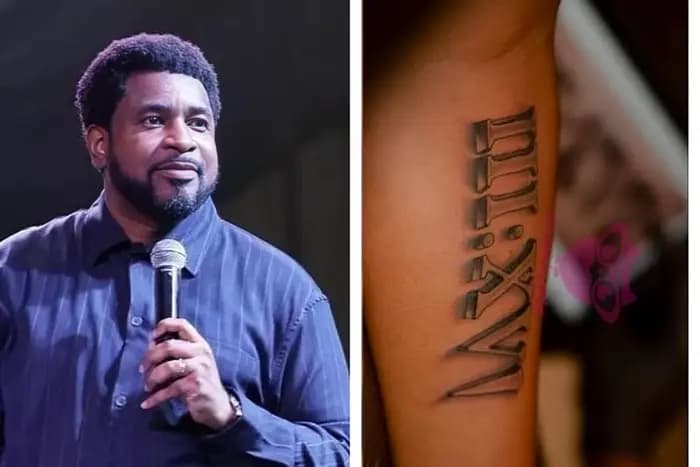
Pastor Kingsley Okonkwo, the founder of David’s Christian Centre, has stepped into the ongoing debate among Nigerian Christians regarding body art, insisting that having a tattoo is not a sin. The cleric addressed the backlash following his decision to get inked, framing his stance around biblical context and cultural history.
The conversation around Okonkwo’s body art began around his 50th birthday, when he revealed a tattoo on his arm displaying "III:XVI"—a Roman numeral reference to the famous Bible verse John 3:16. Despite facing criticism from conservative churchgoers, the pastor expressed no regret and stated he would be willing to get additional tattoos in the future.
Speaking during a recent interview on TVC, Okonkwo pointed out that body markings have been deeply woven into human heritage and Nigerian traditions for generations, long before modern tattoo culture emerged.
“I was born and bred in Lagos. There were those older men all over Lagos then that you see tattoos,” Okonkwo shared. “It has always been part of human culture, not even just Nigeria. Everywhere in the world, there are tribal marks; there are different marks.”
Historically, various ethnic groups across Nigeria utilized facial and body marks to communicate lineage, social status, beauty, and community affiliation. However, as Western Christianity and colonial influences spread, missionary groups often discouraged indigenous body markings, casting them as pagan practices. This historic shift heavily influenced the conservative attitudes many modern Nigerian Christians hold toward tattoos today.
To address the theological concerns raised by critics, Okonkwo referenced passages from scripture to support his view that permanent markings are conceptually present in the Bible. He cited Isaiah 49:16, where God tells His people, “I have engraved you on the palms of my hands,” arguing that biblical authors understood the concept of permanent marks symbolizing lasting memory and dedication. He also pointed to Revelation 19:16, which symbolically describes Christ having "King of kings and Lord of lords" written on His robe and thigh.
Critics frequently counter with Leviticus 19:28, an Old Testament verse that instructs the ancient Israelites not to cut their bodies for the dead or put tattoo marks on themselves. In response, Okonkwo argued that the commandment was tied to specific pagan rituals of that era and questioned why modern believers apply Old Testament ceremonial laws selectively.
“If there is no scripture that says tattoo is a sin, where did these people get it from?” he questioned.
Okonkwo compared the taboo around tattoos to past religious debates regarding cultural choices. He noted that practices such as women wearing trousers, applying makeup, wearing wigs, using perfume, and watching television were once strongly condemned by traditional churches before becoming widely accepted.
For Okonkwo, his John 3:16 tattoo serves as more than personal expression—it represents a broader push for Christians to re-examine the distinction between biblical doctrine and church traditions.
 02 Oct 2026
Likes & Comments
No comments yet. Be the first to comment!
To like or comment, please open the mobile app. Open app